- Inside Health's Newsletter
- Posts
- Motivation Isn't the Problem
Motivation Isn't the Problem
Science explains why habits (not willpower) run your life.

Inside Health Weekly
Welcome to the last Inside Health newsletter of the year.
Let’s end it strong.
This week’s topic? Habits.
The tiny, subconscious actions running your life on autopilot.
The way you think. The way you act. The way you grow.
If 2026 is going to be your year, it starts here.
We’re breaking down the science of how habits actually form, and how to build ones that stick.
Scroll on. Your future self will thank you 👇🚀
Breaking Bad (Habits)
You aren’t lazy or unmotivated if you're stuck in bad habits. Rather, your brain is just repeating behaviors to save energy.
Below are two simple, but powerful tips, backed by neuroscience, that are key to breaking bad habits:
You getting ready to break those bad habits.
(1) Identify your current habits, their triggers, and whether they’re positive or negative. Does the late night trigger binge-eating sugar? Is your phone causing you to procrastinate? Noticing your habits engages the brain’s decision-making center, interrupting repetitive behavior and giving you a chance to choose differently. | (2) Change the environment, replace the old habit, and celebrate it.
Swap in a healthier behavior that provides a similar payoff. Then celebrate that new habit, and you further reinforce it. |
Inside Health Recommends…
📘 BOOKS
Atomic Habits by James Clear: The go-to playbook for building habits that actually stick. Simple systems and clear frameworks you can use today.
The Power of Habit by Charles Duhigg: Breaking down the habit loop (cue → routine → reward) with real-world stories and psychology.
Tiny Habits by BJ Fogg: Behavior science from Stanford. A great read to focus on making habits so small that they are impossible to skip.
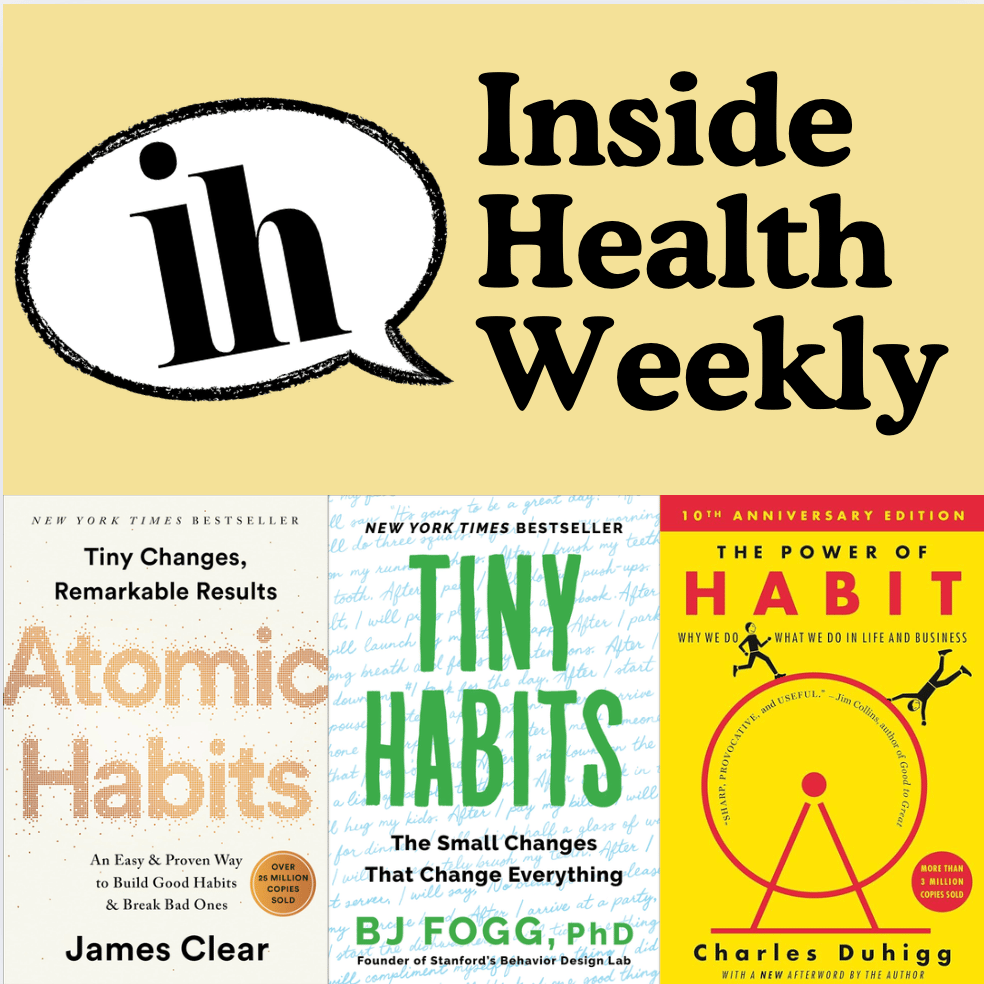
Have you read any of our Weekly Picks?
📺 VIDEO
Wendy Wood - The Power of Habits (Big Think)
One of the top habit researchers. Explains why habits (not motivation) run most of your daily behavior.
Judson Brewer - A Simple Way to Break a Bad Habit (TED)
Using neuroscience and mindfulness to explain craving loops in the brain. A great takeaway on why curiosity can weaken bad habits.
Lisa Feldman Barrett - Interviews on the Predictive Brain (Dairy of a CEO)
Explains how the brain predicts behavior on past patterns (aka habits on a neural level)
Inside Health x Habit-Tracking
Building habits your brain actually sticks to.
Habits don’t fail because you lack discipline; they fail because your brain wasn’t designed for willpower alone.
That’s why Inside Health is teaming up with Habitica, a habit-tracking app that turns behavior change into something your brain loves: progress, feedback, and reward.
Habitica gamifies habit-building using dopamine-based reinforcement, helping transform small, repeated actions into routines that stick… exactly how the brain learns best.
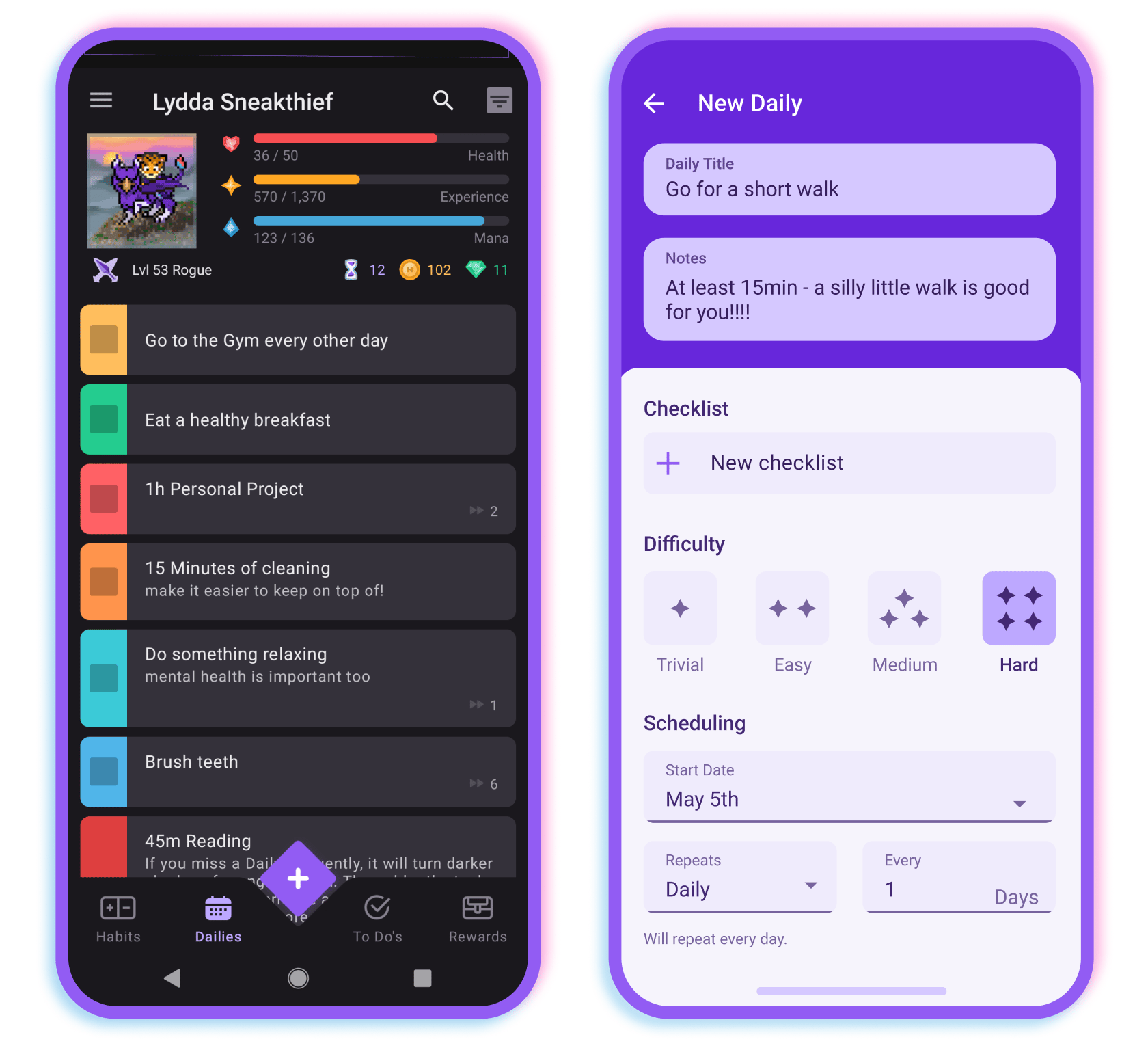
Try it Today! Make productivity your best friend
SCIENCE - The Neuroscience of Habits
The neuroscience behind habit formation falls under this complex interplay of neuroplasticity and neurochemicals. These two work in harmony to drive our behaviors, motivate our decisions, and influence our quality of life.
Although the neuroscience seems daunting, we’re here to flip that narrative so you can enter 2026 ready to crush those goals you’ve been putting on the back burner.
→ Our environments, cognitive processes, behaviors, and neurochemicals form habits. The basal ganglia in the brain house each of these components and make goal-oriented actions, or habits, from these. It is responsible for performing those repetitive actions mindlessly, such as brushing your teeth.
→ The key chemical prevalent in the basal ganglia that drives habit formation is dopamine. Dopamine is powerful – it causes us to seek, to want, to desire, and therefore, drives our behavior. It is the tool behind your curiosity and motivations.
→ So here’s the kicker – something called the dopamine loop is what fixates you on certain habits. The dopamine system is sensitive to “cues”. For instance, you hear the bells from the ice cream truck, and you perk up from the sound to go see that load of joy– that sound is a cue.
We are more sensitive to cues of a reward, NOT the reward itself.
ON THE NEWS
ChatGPT & Habits:
New Research is exploring how AI Tools like ChatGPT influence learning habits, reflection, and consistency when acting as external accountability systems and cognitive helpers.
Early Findings Suggest:
AI-guided reflection and reinforcement of positive routines
Personalized prompts = higher follow-through
Consistency improves when friction is removed
Bottom Line: The future of habit-building might be human + AI, not only willpower alone.

Want to learn more? Click Here.
SCIENCE: Habit Loops, Explained.
Everything around us serves as a cue. They can be the premise of good or bad habits.
CUE | HABIT |
|---|---|
Boredom after dinner | Late-night snacking |
Waking up and checking your phone | Staying in bed scrolling for an hour |
Feeling overwhelmed | Hitting the nicotine |
→ What makes breaking habits hard to stop? That combination of a dopamine rush and a motor response (i.e., your thumb continuously scrolling on TikTok).
Here’s the good news– because of something called neuroplasticity, or our brain’s insane ability to get rid of old connections and form new ones, it gives us the opportunity to break bad habits, regardless of how hard it may seem.
It’s what makes saying “New Year, New Me!” possible.
ON THE MARKET
Did you know that the neuroscience of habits is quietly moving the economy? Let’s break it down.
Market’s don’t run on logic alone. They run on human brains which are predicable, emotional and habit driven.
Habit Loops = Consumer Demand
At a neural level, habits form through a cue → routine → reward loops (basal ganglia). Companies design products to fit into these loops.
Market Impact:
Daily use products (coffee, skincare, supplements) outperform one-off purchases
Subscription models thrive because they reduce decision fatigue
Brands that become “automatic” win long term-loyalty

Bottom Line: Repetition strengthens neural pathways → repeated buying behavior.
💬From Cordelia:
Thank you for tuning in today! I hope you enjoyed this week’s newsletter!
Before we close out the year, I just want to say thank you.
Inside Health started as a simple idea: that people deserve to understand their bodies, their brains, and their health, without needing a medical degree to do it. The fact that you chose to read, share, respond, and believe in this mission means more than I can put into words.
Every click, message, conversation, and moment of curiosity has helped turn Inside Health into a growing community built on science, clarity, and empowerment. I’m endlessly grateful to have you here.
This is just the beginning, looking forward to 2026!
That’s everything for now! Thanks for hanging out with Inside Health this week. Understanding how you function starts with education, and you’re already doing the work just by being here.
Until Next Year! —The Inside Health Team.
